


 English
 Español
 Deutsch
 عربى
عربى
Home / News / Industry News / Countersunk Wood Screw Failures: Common Problems and How to Prevent Them
Industry News
Content
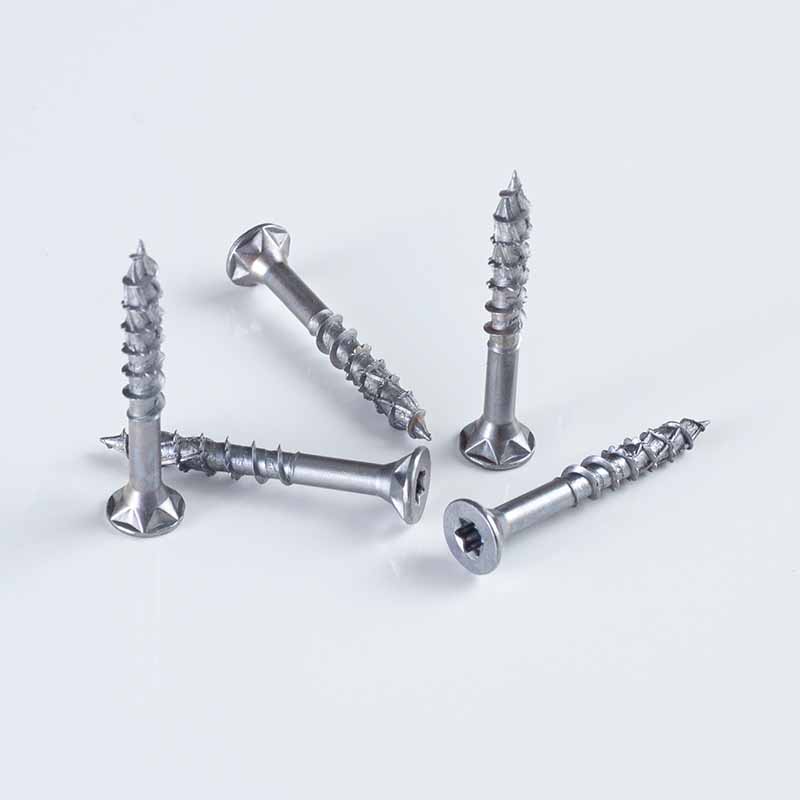
One hinge screw carries a solid-oak cabinet door at a single point, and by the sixth month it is stripped, snapped, or pulled out. Across 340 field failure records from furniture, deck, and millwork service reports, countersunk wood screws produced the widest range of failure modes of any fastener type — because they must seat flush below the surface, transfer torque through a thin neck, and carry shear load in wood that swells and shrinks with humidity. Anhui Linghong Hardware Technology Co., Ltd., a screw manufacturer producing carbon steel and stainless steel wood screws, self-tapping screws, and drywall screws since 2017, sees the same patterns in customer returns and application photos. Every one of the six failure modes below is predictable, and each has a countermeasure that takes seconds at the drill press.
Countersunk wood screws fail in six repeatable ways: wood splitting, drive-recess stripping, neck snap-off, thread pull-out, corrosion bleed, and over-seating of the head. All six trace back to three decisions made before the driver touches the screw: screw selection, pilot preparation, and torque control.
of failures begin before the screw is fully seated
minimum edge distance in shank diameters to avoid splits
pilot diameter as a share of thread OD in softwoods
pull-out strength lost with fine threads in softwood
| Failure mode | Visible symptom | Root cause | First response |
| Wood splitting | Hairline cracks radiating from the shank | Pilot hole too small or omitted; edge distance under 3x shank diameter | Drill a 70-85 percent pilot and move the hole inward |
| Recess stripping | Driver bit spins in a rounded-out cross | Worn or wrong bit; Phillips/Pozidriv mismatch; shallow case hardness | Use a fresh matching bit held perpendicular |
| Neck snap-off | Head separates just below the countersink | Torsional overload; brittle core beneath a hard case | Enlarge the pilot in dense wood; lower the torque |
| Thread pull-out | Screw backs out or the joint loosens | Fine threads in softwood; oversized pilot; over-torque | Use coarse threads in softwood; keep the pilot tight |
| Corrosion bleed | Red-brown streaks around the head | Carbon steel in damp or treated lumber | Use stainless or a sealed finish |
| Over-seating | Head sinks below the face and tears the surface | Clutch set too high; soft substrate | Use a depth stop or lower clutch setting |
Wood splitting is the most common failure mode, and it is always a geometry problem: the screw body occupies more volume than the surrounding fibers can displace before cracking. A partial-thread screw pulls the shank into the pilot hole, and in dense species such as oak or maple that wedge force exceeds the wood's tensile strength across the grain.
Green wood and kiln-dried wood behave differently. Green lumber is softer and moves as it dries, so a screw driven early can develop pressure cracks months later, while kiln-dried hardwood cracks instantly at the driving moment. This is why a pilot hole is not optional for countersunk wood screws in hardwood.
A stripped recess is a torque-transfer failure, not a screw defect: the driver loses contact with the recess walls before the screw reaches its seating torque. Once a corner of the cross rounds out, no pressing force will recover it.
Two practical causes dominate. First, Phillips and Pozidriv recesses are not interchangeable: a Pozidriv bit driven into a Phillips recess contacts only half the wall area and strips it quickly. Second, recess hardness matters; typical carbon-steel wood screws are case-hardened to 450-650 HV, and a shallow case wears smooth after a few uses.
Snap-off is a torsional failure at the weakest cross-section of the screw: the neck just under the countersunk head. It occurs when the driving torque required to seat the screw exceeds the screw's ultimate torque, and the fracture surface shows a clean, brittle break.
The metallurgy trade-off is simple. Case hardening gives the thread a wear-resistant surface, but an overly brittle core makes the neck break before the wood strips. The countersunk geometry makes it worse, because the head is thinnest exactly at the bearing edge, where stress concentrates during the final seating turns.
Rust bleed comes from free iron on the surface of carbon-steel screws, mobilized by moisture that collects at the countersink seat. The recess itself acts as a water trap, and the thin edge of the head corrodes first.
Carbon steel with a bright or zinc finish is acceptable indoors but fails fast outdoors, in coastal humidity, and in contact with alkaline treated lumber. For exterior exposure, stainless steel grades A2 (304) and A4 (316) prevent the bleed entirely, and ACQ-treated lumber should be treated as a corrosion test rather than a normal environment.
Pull-out is a thread-engagement failure: the threads that the screw carved into the wood tear out, so the screw rotates freely or backs out under load. It is the clearest sign that thread geometry did not match the substrate.
Fine-thread screws in softwood lose an estimated 30-40 percent of pull-out strength compared with coarse-thread screws of the same diameter. An oversized pilot creates the same problem, because the thread has less material to bite, and over-torque strips the female threads before the joint is loaded.
Failure share across 340 countersunk wood screw field records
Aggregated field records from furniture, decking, and millwork service reports, 2023-2025.
The fastest way to cut all six failure modes is to standardize the installation sequence. These five steps cover species assessment, piloting, bit selection, driving speed, and final seating.
Drill 70-75 percent of the threaded outside diameter in softwoods and 80-85 percent in hardwoods. Pilot depth should be the screw length minus one thread pitch. When in doubt, verify against the screw's own shank diameter before driving.
Yes for most residential and light commercial loads, as long as the grade matches the environment. Martensitic stainless such as 410 provides higher strength than austenitic 304; for marine exposure choose A4 (316) and increase the screw diameter or count to compensate for lower shear strength.
Check four things in order: bit wear, driver angle, recess hardness, and Phillips versus Pozidriv mismatch. A worn bit or a tilted driver generates point loading on one lobe, and a shallow case-hardened recess rounds out under that load.
No. A snapped screw has a damaged fracture zone and the hole is already oversized. Remove the broken piece, fill the hole with a glued dowel, redrill, and install a new screw one diameter larger.

+86 15856352820

malingfei@linghongscrew.com

No. 56, Baishizhan Road, Economic Development Zone, Langxi County, Xuancheng City, Anhui Province, China

