


 English
 Español
 Deutsch
 عربى

Home / News / Industry News / How Self Tapping Screws Work: Thread Forming, Torque and Coating Choice
Industry News
Content
A technician presses the point of a pan-head screw against a 1.5 mm galvanised bracket, leans into the driver, and squeezes the trigger. Two seconds later the joint is tight. No nut, no weld and no pre-cut thread were involved: the screw created its own thread inside the steel and now holds through friction and clamp load.
Self-tapping screws work by cold-forming a matching internal thread in the base material, displacing it instead of cutting it away. When the head seats on the surface, the screw stretches elastically while the material around it compresses, and that stored tension is what keeps the joint tight under vibration.
That single mechanism explains most of the practical behaviour engineers and buyers argue about: why pilot holes help in hardwood and cause problems in soft plastic, why the torque window between seating and stripping is narrow, and why a screw that performs well in timber can fail in 0.8 mm sheet metal.
From first contact to final clamp load, three stages run in sequence, and each asks something different from the material.
Two torque values define success: the seating torque that creates clamp load, and the stripping torque at which the formed thread shears away. In thin sheet and plastics the gap between them is narrow, so a torque-limited driver set at roughly half to two-thirds of the measured stripping torque is safer than working by feel.
Thread geometry matters as much as material. A coarse pitch forms threads quickly and suits timber and light gauge sheet, but fewer crests carry the load. A finer pitch engages more thread turns and resists pull-out, at the cost of higher forming torque and slower driving.
Most fasteners sold as self-tapping are thread-forming: they push material aside and leave no chips. That suits ductile materials such as low-carbon steel, aluminium, ABS and most timber. In brittle materials, or in sections thick enough that displacement would crack the part, a thread-cutting version is used instead. Those have a flute or slot ground across the point that creates a cutting edge and clears chips as the screw advances.
Point style is usually written into the part number, which is why order codes look cryptic until you decode them.
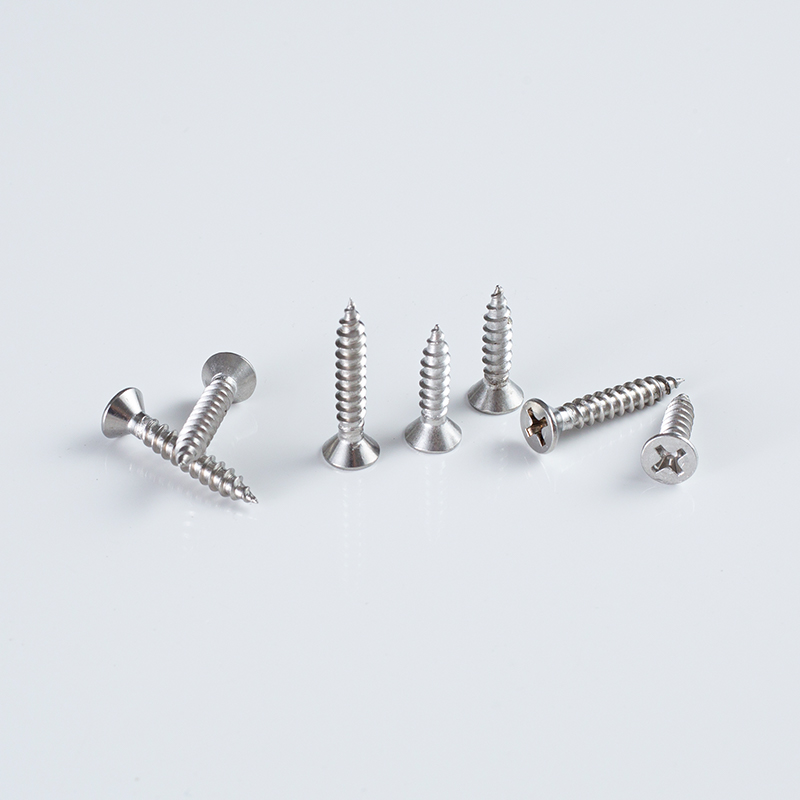
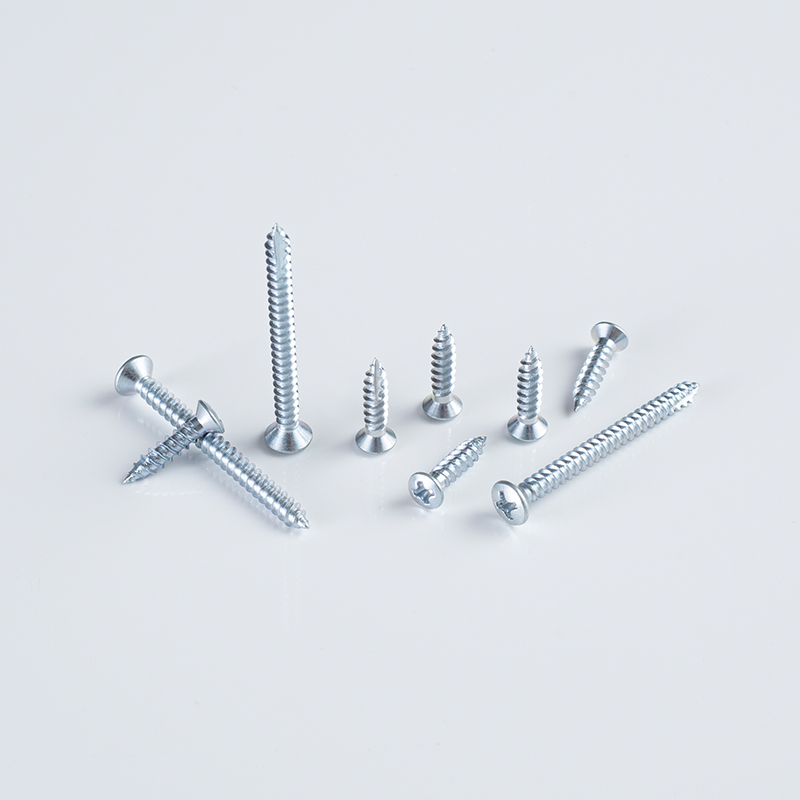
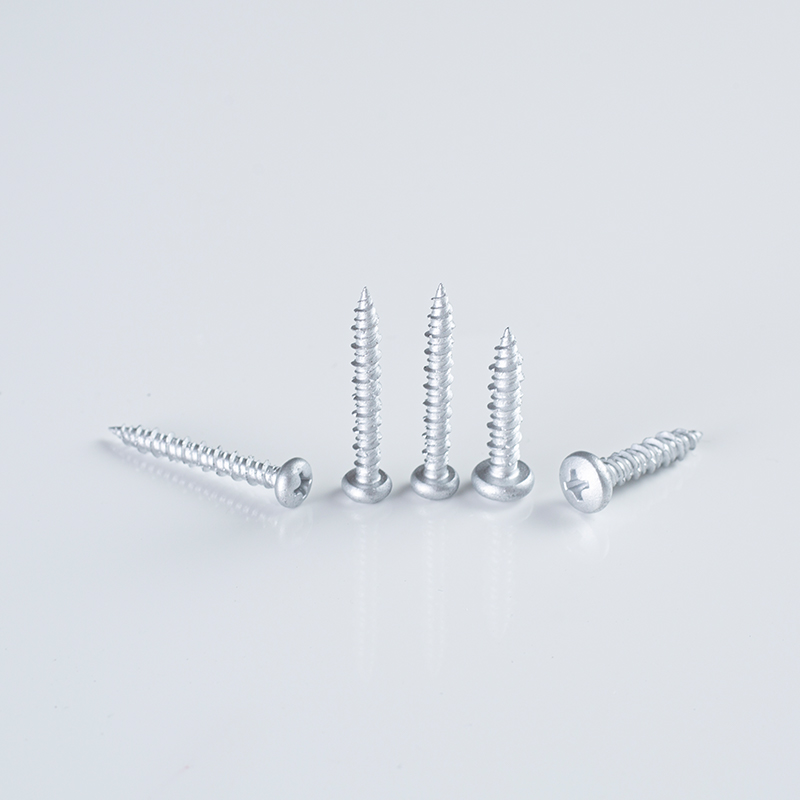 Silver Ruspert Pan Head Phillips Hi-Lo Self-Tapping ScrewCarbon steel self-tapping screw with silver Ruspert finish, pan head, Phillips drive and Hi-Lo thread, relevant when comparing easy-starting thread forms and load-bearing depth.View Product →
Thread form follows the same logic. Hi-Lo and three-stage threads start easily in plastic and particle board because the leading threads are narrower than the load-bearing ones behind them, so initial forming torque stays low while final pull-out strength comes from the full-depth section.
The two families share a driver and a head style, and they are often mixed up in quotes and purchase lists. The difference is whether the screw drills its own hole or needs one prepared for it.
| Factor | Self-tapping screw | Self-drilling screw |
|---|---|---|
| Point | Sharp, tapered or slotted | Drill-shaped cutting tip |
| Pilot hole | Needed in most metal and hardwood | Not needed in the recommended thickness range |
| Material removal | Displaces material, no chips | Cuts and clears chips at the tip |
| Typical substrate | Sheet metal, plastic, timber, drywall | Steel cladding, purlins, drywall to steel |
| Practical thickness limit | Roughly 2 mm to 3 mm in steel for standard sizes | Usually up to 6 mm steel, depending on tip size and diameter |
| Labour profile | Extra drilling step per fixing | One operation per fixing |
On a roof or a stud wall with hundreds of fixings, the labour saved by skipping the pilot hole is the whole reason self-drilling screws exist, and it normally outweighs their higher unit price. The trade-off is less forgiving behaviour: a blunt tip, too little axial pressure or excessive speed can work-harden stainless sheet and burn the point before the thread engages. This comparison of self-tapping and self-drilling labour costs covers the arithmetic buyers use when both options are technically acceptable.
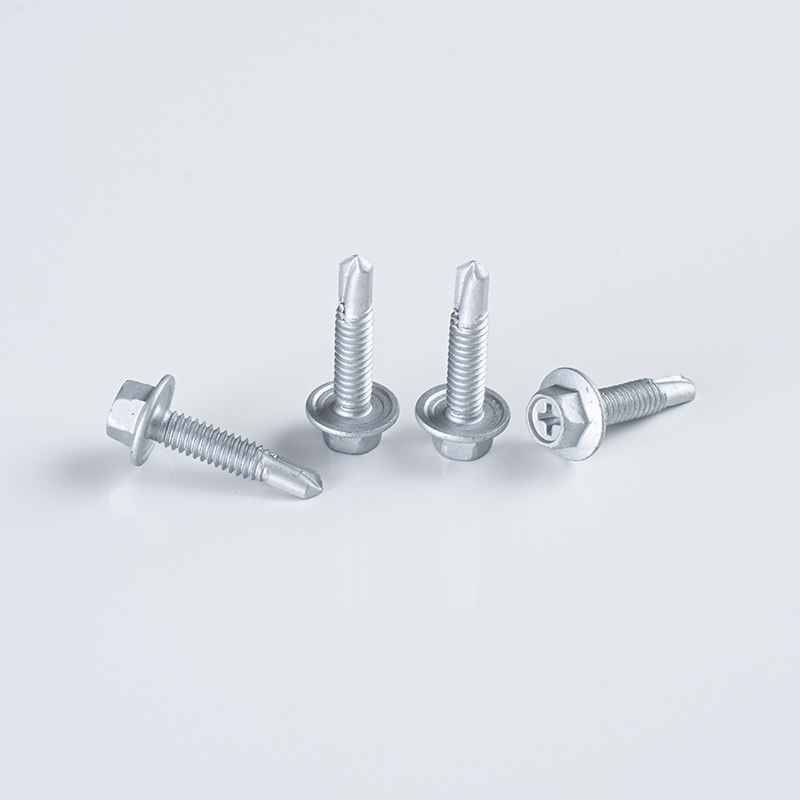 Carbon Steel 10-24x25 Ruspert Silver Hex Washer Head Self-Drilling ScrewCarbon steel self-drilling screw in 10-24x25 with Ruspert Silver finish and hex washer head, relevant where indoor assembly favors skipping pilot holes.View Product →
Carbon steel covers the bulk of indoor assembly work. Stainless covers everything that sees moisture, chloride or cleaning chemicals, and the grade decision is usually made by the environment rather than by strength requirements.
On carbon steel, the coating rather than the base metal decides how long the joint survives. Zinc plating gives basic protection, black phosphate is chosen for dry indoor assemblies, and zinc-nickel, Ruspert and Dacromet systems are specified where salt spray results of 500 to 1000 hours are required. Those figures come from laboratory tests on coated parts, so treat them as a ranking tool between finishes rather than a warranty for a specific installation.
Two practical traps are worth flagging. Pairing a stainless screw with an aluminium panel concentrates corrosion on the aluminium because of the potential difference between the metals, so a coated steel screw or an insulating washer is often the better choice. Stainless screws also gall when driven fast into stainless nuts or thick sections, and slow speed with a wax-based lubricant prevents cold welding of the threads.
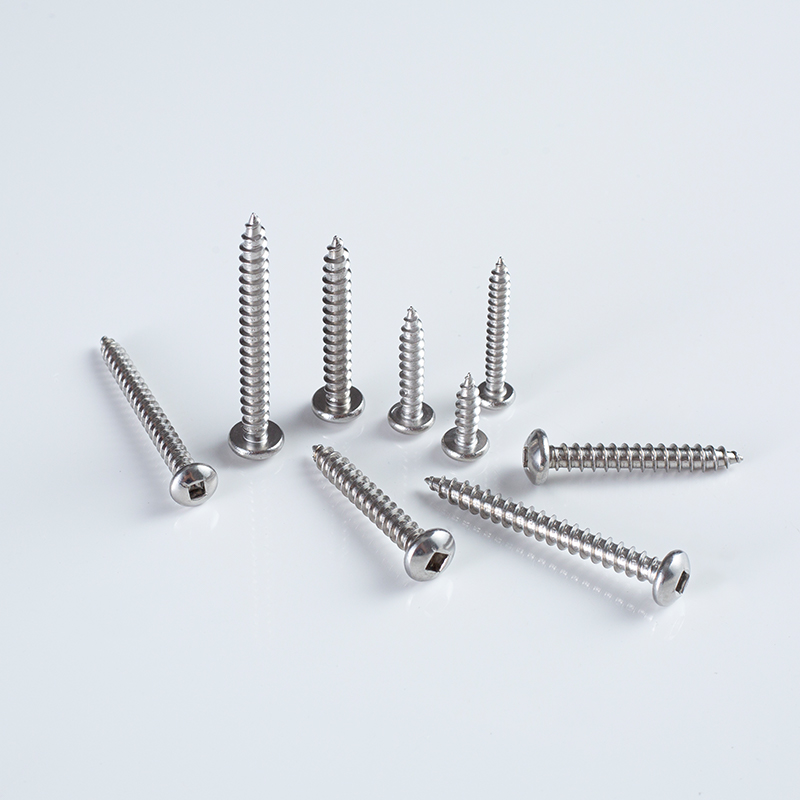
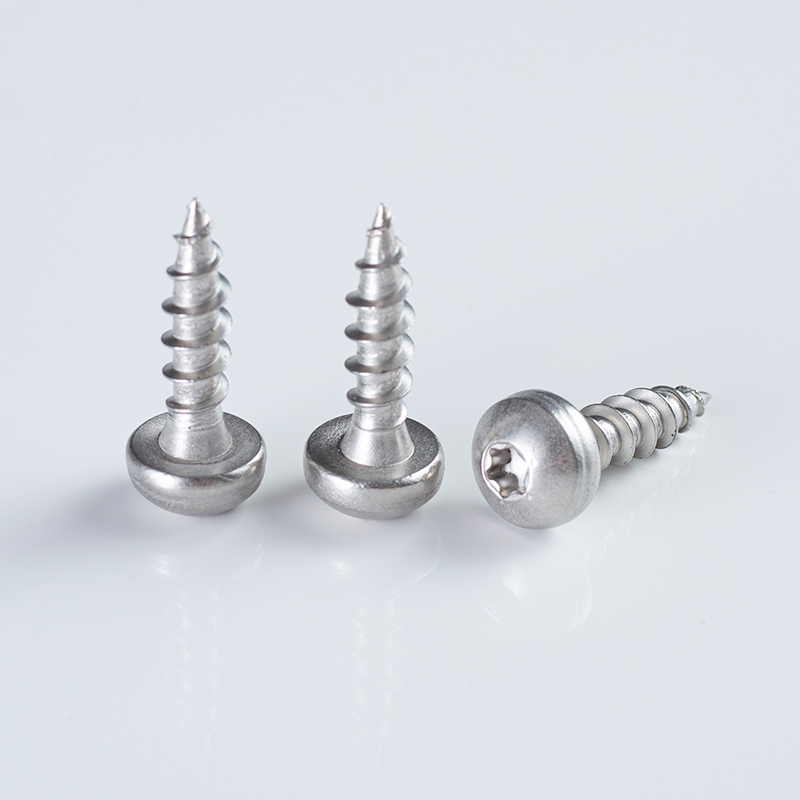 SS304 Stainless Steel Pan Head Torx Self-Tapping Screw 10-16x16-25SS304 stainless steel self-tapping screw with pan head and Torx drive, worth reviewing when stainless fastener choice and pilot-hole sizing are being weighed.View Product →
Hole size is the single variable that most often decides whether a self-tapping screw strips, splits the part or holds. The table below gives starting points that should be confirmed on a scrap piece of the actual material.
| Substrate | Starting pilot hole | Watch out for |
|---|---|---|
| Hardwood | Roughly 70 to 90 percent of the screw core diameter | Splitting along the grain; a T17 point helps |
| Softwood | Often unnecessary for small diameters | Stripping in porous grain; reduce drive torque |
| Steel sheet 0.8 to 1.5 mm | Close to 85 percent of the nominal screw diameter | Thread stripping when the hole is too large |
| Aluminium sheet | Approximately 90 percent of nominal diameter | Material build-up on the flanks raising torque |
| ABS, PP and other plastics | Similar to or slightly larger than the screw diameter | Hoop stress cracking if the hole is too small |
| Drywall over steel studs | No pilot hole; the screw forms through the board | Torn paper and a crushed board from over-driving |
Measure stripping torque once on the real joint, then set the driver to stop well below it. A screw that strips its own thread in thin sheet loses most of its clamp load even though it still looks installed.
The sequence of a good installation is short and repeatable:
Buyers reviewing a specification should ask for point type, thread form, material grade and coating in writing. Part numbers that encode all four, such as a 4.2 x 32 three-stage blue-white zinc screw, make repeat orders far less risky than a description that states only diameter and length.
In steel, aluminium and hardwood, yes. The pilot hole controls thread engagement and prevents the material from cracking or the thread from stripping. In softwood, drywall and some plastics, a screw can be driven directly, especially with a sharp point or a T17 slot.
It can be removed, but the formed thread usually loses some material on the way out. Re-driving the same screw into the same hole gives noticeably lower pull-out strength, so reuse is acceptable for access panels rather than load-bearing joints.
Type A has a sharp point and coarse thread for thin sheet. Type B has a finer thread and a less tapered point for heavier sheet. Type AB combines both and is the general-purpose choice in mixed assembly work.
Stainless surfaces carry a passive oxide layer that can weld under heat and pressure, a process called galling. Slower drive speed, a correct hole size and a light wax lubricant on the thread reduce the risk considerably.
Treat a self-tapping screw as a forming tool rather than a fastener with a sharp end. Match the point to the substrate, size the hole to the thread core, and choose the coating by exposure rather than by price, and the joint will behave the way the drawing promises.
For assemblies that combine drywall, steel framing and decorative finishes those principles hold across the whole fixing schedule, and our overview of construction and interior decoration applications shows how these screws are specified in practice.

+86 15856352820

malingfei@linghongscrew.com

No. 56, Baishizhan Road, Economic Development Zone, Langxi County, Xuancheng City, Anhui Province, China

